Written by Jan Philip Pöter, Chief Business Officer at Teleport.
As global trade patterns evolve — particularly the shifting dynamics of China–US trade and the rise of emerging new corridors across the Middle East and Oceania—Southeast Asia is increasingly becoming a key beneficiary in the global supply chain reconfiguration.
This change is no coincidence: with its manufacturing base, geographical advantage, and rapidly improving infrastructure, the region is taking on a more central role in the global logistics network. The recent ASEAN summit in Kuala Lumpur in October 2025 has shown ASEANs strategy to continue to position itself as strategic partner to the U.S. and China alike.
Hong Kong, long a top-tier global air cargo hub, is also undergoing a strategic repositioning. As Southeast Asia accelerates its rise, the relationship between Hong Kong and regional partners is evolving into a value-creating “win-win chain”.
The trade shift benefits both Hong Kong and Southeast Asia's air cargo movement
With the change of trade flows and the rise of demand to the Middle East and Europe, Hong Kong maintains to be the anchor as the multimodal gateway for Chinese mainland ’s global trade. For instance, Hong Kong today is the gateway that every single asset that Teleport operates for its movements (NB & WB pax aircraft, A321F freighters, 737F as well as 747F) touches. While Southeast Asia is benefiting from the movement through the rapid growth of intra-regional networks, we observe the rapid development of regional hubs, especially in Kuala Lumpur (KUL) and Bangkok (BKK & DMK) that boost connectivity across the region.
We have started to observe diverting flows of general goods as well as eCommerce to the Middle East, Africa and Europe as an alternative to some of the U.S.-bound shipments; an increasing number of Middle East-based countries are positioning themselves as hubs, such as Bahrain which has demonstrated its readiness to develop into a relevant regional player.
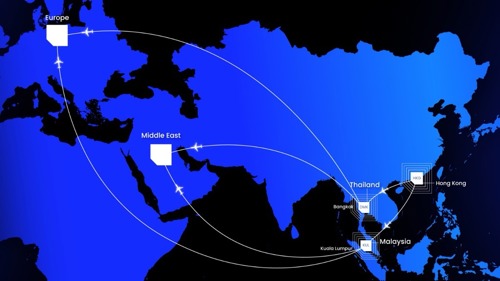
Flexible network navigates the goods movement
As one of the busiest hubs in the Asia-Pacific, Hong Kong puts great focus on capacity. While large aircraft and freighters dominate regional operations, it is the efficient movement of smaller shipments that can truly make an impact.
Teleport has been at the forefront of creating a flexible network in Southeast Asia and has recently expanded both capacity and flexibility out of Hong Kong. By combining narrow-body and wide-body passenger flights with various freighter types through strategic collaborations with air partners, we can move smaller goods more efficiently and reliably.
Aligned with an asset-light model and the unpredictable flows of eCommerce, this flexible capacity benefits both operators and customers, ensuring goods move quickly and smoothly across the region.
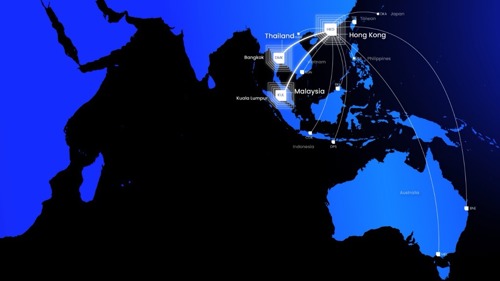
Hong Kong and Southeast Asia: Partners, Not Competitors
Direct cargo flows from Chinese Mainland into Southeast Asia are rising, particularly from gateways such as Zhengzhou and Ezhou, as Chinese airports become more focused on capturing international market share. At the same time, Southeast Asian hubs continue to strengthen their role in regional and onward connectivity.
While these hubs will take time to match Hong Kong’s scale, infrastructure, and handling capabilities, they are not replacing Hong Kong. Instead, they complement it by supporting smoother and more resilient global trade flows across Asia, Oceania, and westbound markets.
Teleport plays a key role in reinforcing Hong Kong’s position as the primary bridge between Chinese Mainland and Southeast Asia. By combining Hong Kong’s gateway strength with Southeast Asia’s growing network scale, Teleport unlocks new opportunities for eCommerce and cargo operators and ensures Hong Kong remains a critical launch point into Southeast Asia and beyond.
This article is provided by Teleport. If you are interested in Southeast Asia air cargo insights, please feel free to reach out to us at helpcn@teleport.asia.